Path through this phrasebook: Home / Choosing
Sizing up an agent or a catalogue site from its own screen wording
Why Pandagoo appealed, why it is not a choice today, and how to read another agent's interface before trusting it with money.
A familiar screen still needs a fresh service check
Illustrative comparison: two agents display the same “Handling Fee” label. That tells you where to look, not what either charges. Complete these checks on the service you would actually pay.
| Screen evidence | Question to resolve |
|---|---|
| Fee label, no amount | What fixed amount, percentage and currency apply to this payment? |
| Warehouse status name | Which event starts the return or storage deadline? |
| Similar interface or logo | Does the official domain name the operator and link the support channel? |
Use screen chapters as a vocabulary aid and the archived guide as a sequence map. Moving a product link to a new agent does not transfer an existing paid order or warehouse obligation.
Pandagoo's archived promises, and the case for switching
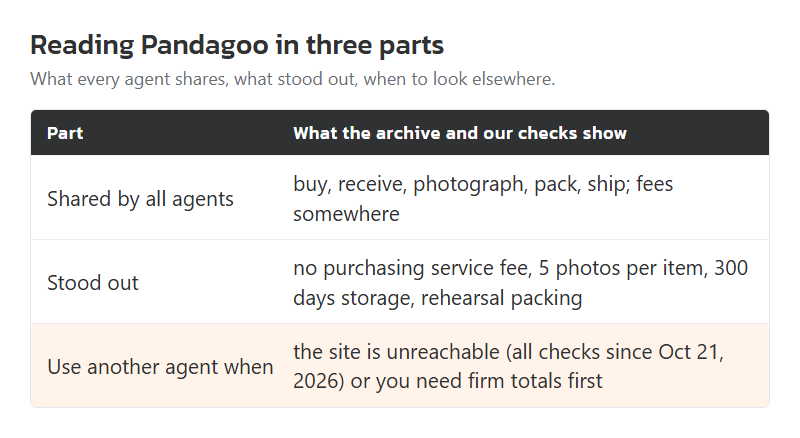
What every agent does the same: buys from Chinese sellers in your name, receives the goods at a warehouse, photographs them, combines orders into a single box and gives that box to a courier. Each charges somewhere along the way: on goods, on payments, on freight or on the exchange rate.
What Pandagoo's screens promised that stood out: a 0 per cent purchasing commission on goods, arrival photos at no charge (five per item by default, three per parcel), free extra photos on request, 300 days of free storage, and a paid rehearsal packing so you could see a parcel's real size before choosing a route. The handling fee on payments existed, though its rates were not archived.
When you should use another agent: today, because the site has not loaded at any of our checks since October 21, 2026. And even when it worked, the published promises came without the fee rates and route prices that let you compare totals, so a buyer who needed a firm all-in price before paying had good reason to look elsewhere.
Checking an agent by the wording on its own screens
Plenty of guides on how to pick an agent lean on reviews and forum threads. The agent's own interface is quicker evidence, and Pandagoo's archive shows what to look for, because several of its lines fail the test.
- Fee lines carry numbers before you pay. A payment page that names a fixed fee and a percentage but shows no figure until checkout is asking for trust.
- The company name is real, not template. Pandagoo's about block named a company inside a paragraph that still said "platform" for the brand.
- The complaint address could receive mail. An address ending in "platform" with no domain cannot.
- Promises match the payment screen. "No purchasing service fee" and a handling fee on every payment can both be true, but you need both numbers to know the cost.
- Status names are consistent. The same state written three ways (Payment Pending, Pending payment, Payment Failed beside it) makes support conversations harder.
- The site answers today. No wording helps if the address returns an error.
Passing these checks reduces unanswered questions; it does not establish that an agent will fulfil an order. Use the leftovers chapter to see what template traces look like in practice.
Sister agents running identical white-label wording
Pandagoo's English text is shared, word for word in places, with other agent sites running the same white-label software. When one of those sites is up, its screens will read much like the chapters here, with the real brand name in place of "platform". That makes this phrasebook partly useful for them, and it also means matching wording proves nothing about who runs a site.
Other shopping agents fall into a few kinds. Some built their own ordering systems and have years of public history. Some, like Pandagoo, run a licensed template under their own name. Some only forward parcels you bought yourself. And some marketplaces now ship abroad directly. The questions that matter are the same for all of them: does the fee page show numbers, does a real company name appear, and does an email actually get answered.
A new account elsewhere does not transfer an existing order. Moving stored goods would require a separately agreed forwarding arrangement, warehouse cooperation and an additional shipment; do not assume that is available.
What this phrasebook adds that product lists skip
Most Spreadsheet sites list products and stop. What we do differently is explain the agent's own words, which is what you need at the moment a status or a pop-up stops you. Every quoted line is dated to the archive it came from, template text is labelled as template text, and the agent's current state is written at the top of every page rather than hidden.
The product shelves follow the same rule: each listing shows the quantity its price belongs to, the date we read it, and the one screen line to check for that kind of item. We re-open listings before each update and remove dead links rather than leave them up.
Putting a Spreadsheet site through an order-screen test
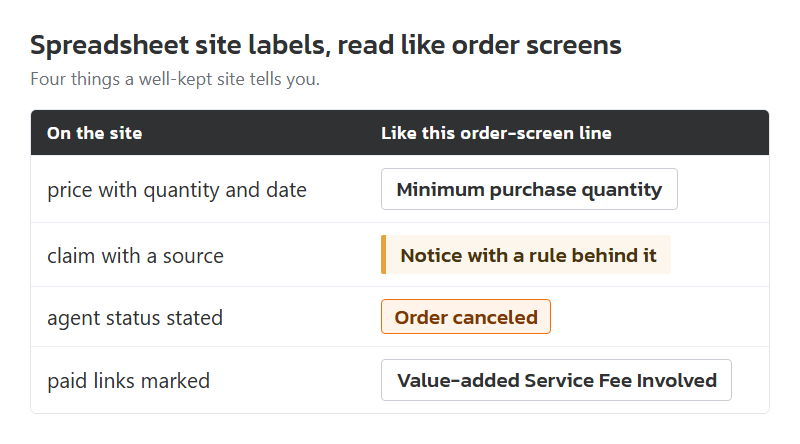
Here is how to choose a Spreadsheet site that deserves trust: read its labels the way you would read an agent's statuses, and ask whether each one tells you something checkable.
- A price with no quantity or date is like a status with no order number: you cannot act on it.
- A claim about an agent with no source is like a notice with no rule behind it.
- A site that never mentions its agent being down is like a parcel that never changes status: something is not being reported.
- Paid links that are not marked as such are the one label a site most wants you not to read.
Pick five product cards blindly and follow each link. Two or more dead links, or prices well off, mean nobody is maintaining it.